When it comes to industrial construction, reliability is non-negotiable. For contractors in...
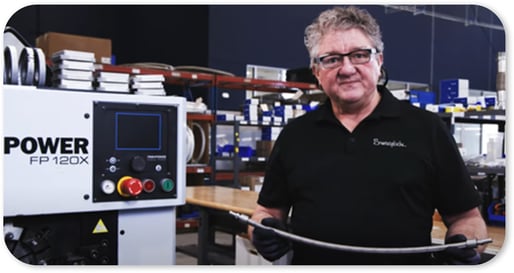
At Swagelok Minnesota | North Dakota | Appleton, building a custom hose is a detailed, hands-on process rooted in consistency and care. Mark, a technician on the design and assembly team in Chaska, MN, walks us through how hoses are built from order to shipment.
From exacting measurements and specialized fittings to thorough leak testing, we ensure each hose meets the highest performance standards. With our attention to detail, advanced testing methods, and commitment to consistency, Swagelok hoses are built to handle the most demanding applications with confidence
Inside Swagelok’s Industrial Hose Build Process
Step 1: Configuration
Everyday Swagelok’s Design and Assembly assembly team logs into an internal system to review commercial hose assembly orders. Mark inputs the details into the hose configurator and pulls parts from Swagelok’s inventory of hoses, connectors, and fittings, ensuring complete compatibility and performance across the entire assembly.
Step 2: Hose Customization
Utilizing the TigerStop, a precision cutting system, Mark is able to program to exact hose dimensions which delivers a clean, precise cut, matching the configurator’s specifications. Upon verification of the cut length, the hose is assembled with specialized fittings and connectors before being transferred to the crimping station.
Step 3: Crimping for Accuracy
There, a specialized hydraulic press secures the collars onto a Swagelok hose or flexible tubing, creating a strong, leak-resistant bond. Once crimped, each end is measured to verify it meets the configurator’s dimensional specifications. Mark then checks the total length of the hose again to ensure accuracy.
Step 4: Pressure Testing Accuracy
With the hose fully assembled, it's time for testing. Mark preloads the hydrostatic tester with the proper fixtures for the hose being built. He then fills the system and the hose with water and brings it up to 1,000 PSI — the pressure required for this specific test. Testing commences after hose assembly. Mark prepares the hydrostatic tester with the correct fixtures for the hose model. He then introduces water into the system and hose, pressurizing it to 1,000 PSI, the necessary level for this test.
Step 5: Leak Testing Verification
The hose is held under pressure for 30 seconds while being closely monitored for any leaks or signs of failure. If the hose passes, it’s depressurized and removed from the test system.
The final steps involve cleaning, packaging, and preparing the hose for shipment. Only after passing this full process is the hose cleared for delivery to the customer.
This careful and repeatable approach ensures that every Swagelok custom hose is ready for the demands of real-world use.
Swagelok's Industrial Hose Advisory Services
Eliminate a variety of hose-related issues that cause safety concerns, unplanned downtime, low product yield, or costly part replacements by engaging with Swagelok® hose advisors , Swagelok Minnesota | North Dakota | Appleton onsite site evaluations and provide prioritized improvement recommendations.